Demand Everything from Your Motor Controller — How Samarth Delivers 98% Efficiency, 0.1 s Response, and 25 µs Protection

Modern electric two-wheelers succeed or fail not just on their motors, but on how intelligently those motors are controlled. Most controllers still corner OEMs into old trade-offs — choose between razor-sharp response, rock-solid reliability, or peak efficiency — and settle for less on the rest.
But at Samarth E-Mobility, we built our controller platform on a single principle: no compromises.
Breaking the Controller Trade-Off
Traditional traction inverters are victims of the “pick two” dilemma — pick any two of responsiveness, reliability, or efficiency, and sacrifice the third. Push for sub‑0.2 s torque response, and you risk high switching stress and thermal load. Tune for conservative fault protection, and the system slows down. Optimize for efficiency alone, and stability suffers at the edges.
Samarth’s answer is redesign from the ground up — hardware, firmware, and algorithms built to work together instead of against each other. The result? Race‑level dynamics, bulletproof protection, and 98% efficiency treated not as competing objectives, but as a unified design philosophy.
In-House Control Architecture, Built on Precision Silicon
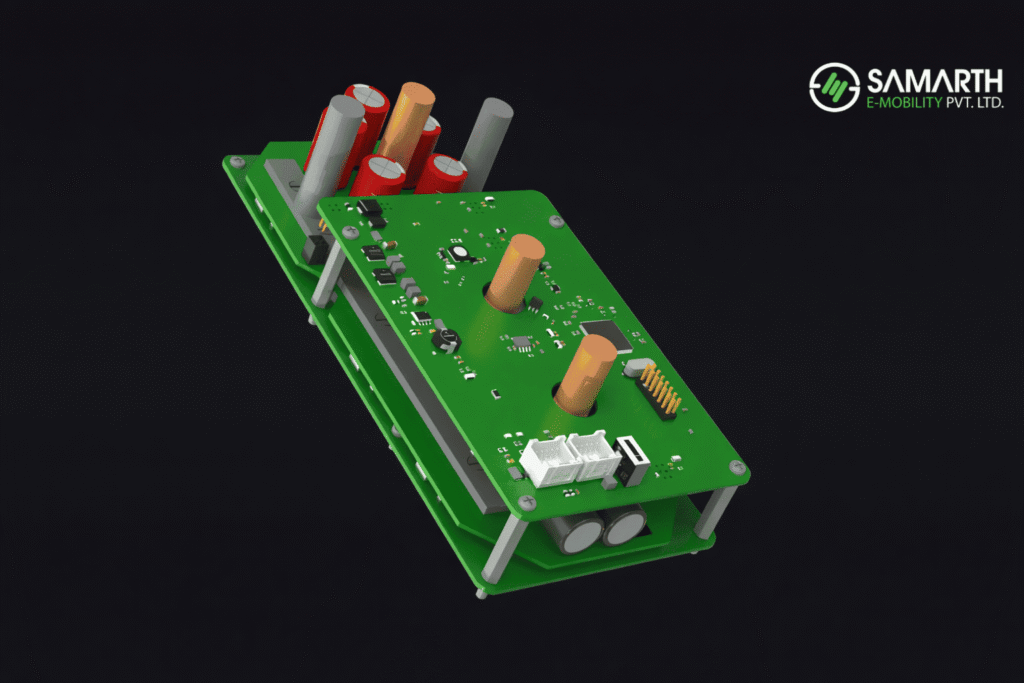
At the heart lies a high‑performance microcontroller engineered for deterministic real‑time behavior, fast ADC sampling, and rich timer/PWM capabilities. This is what enables tight current loops, high‑resolution torque control, and ultra‑fast fault handling — all without exhausting compute budgets.
On this foundation, Samarth deploys fully in‑house control logic. No generic firmware. Every control loop, estimator, and protection parameter is tuned for the specific motor topology and duty cycles of Indian electric two‑wheelers. Torque control, protection, diagnostics, and fail‑safe systems all live within a single integrated architecture, not scattered patches.
0.1-Second Torque Response: Natural, Instant, Predictable
Torque response determines how naturally a rider’s command turns into motion. Samarth targets an approximate 0.1 s torque response, achieved through:
- High‑bandwidth current and speed control loops tuned for stability and responsiveness.
- Optimized PWM/modulation strategies that minimize voltage‑application delay.
- Seamless linkage between throttle mapping, torque requests, and FOC execution.
The result is a “connected” riding feel — instant, smooth, and predictable across traffic, hills, and high speeds alike.
25‑Microsecond Protection: Fast Enough to Prevent Failure
Where others compromise, Samarth accelerates. Our system reacts to faults in ~25 microseconds — fast enough to act before a glitch becomes a failure.
This responsiveness comes from:
- Direct hardware comparators and ultra‑fast ADC triggers on key electrical nodes.
- Interrupt-driven protection paths bypassing slower main control loops.
- Deterministic state machines that instantly decide to shut down, limit, derate, or reconfigure.
Protection here isn’t a checkbox; it’s a proactive shield.
98% Controller Efficiency: Range You Can Feel
Controllers can quietly waste as much as 5% of a vehicle’s stored energy. Samarth’s platform, optimized down to its switching patterns, device selection, and thermal layout, achieves up to 98% efficiency under real‑world conditions.
That 3% margin translates into:
- Cooler operation and improved reliability.
- Additional range from the same battery pack.
- Reduced current stress, extending cell life.
When paired with an efficient motor, every watt counts — and every kilometer stretches further.
Natural Air Cooling for Real Indian Roads
Instead of chasing liquid-cooled lab specs, Samarth designs for real‑world India — dust, vibration, and unpredictable temperatures.
High thermal efficiency keeps heat manageable through natural or forced air cooling, eliminating the need for pumps, hoses, or coolant. This simplicity means:
- Fewer failure points and lower maintenance.
- Simplified assembly and reduced BOM cost.
- Long‑term reliability suited for fleets and retail operations alike.
Predictive Algorithms, Auto‑Calibration, and Fail‑Safe Intelligence
Our software doesn’t just respond — it anticipates. Predictive algorithms learn from system behavior, identifying patterns that precede failures and pre‑emptively adjusting operation.
Auto‑calibration routines further ensure consistency by learning motor‑specific parameters and compensating for real‑world variances.
In case of fault, fail‑safe logic ensures:
- Smooth transition to safe operating states.
- Auto‑recovery when conditions stabilize.
- Rich diagnostic data for service teams — cutting downtime and warranty costs.
System-Level Thinking: A Controller That Amplifies the Motor
Every OEM knows: a motor is only as good as its controller. Samarth’s next‑generation design acts as a performance multiplier — maintaining the motor’s efficiency band, delivering torque accurately, and avoiding wear conditions that damage components over time.
Paired with a Samarth controller, the same motor delivers more performance, better range, and longer life. The controller stops being a commodity part and becomes the defining differentiator.
2026 and Beyond: The Controller as Competitive Advantage
As India’s EV two‑wheeler sector matures, OEMs will realize that “performance vs. reliability” is an outdated debate. The new question is simpler:
Does your control system still make you choose?
Samarth E-Mobility’s in‑house platform eliminates trade‑offs with responsiveness, reliability, and efficiency working in harmony. Built and tested for Indian conditions, engineered for manufacturers who demand it all — this is the control system built for the next generation of electric mobility.

Driving into the Future
Insights, Innovations, and Ideas Driving the Future of Electric Mobility