
10 Critical Design Factors for High-Performance EV Battery Packs
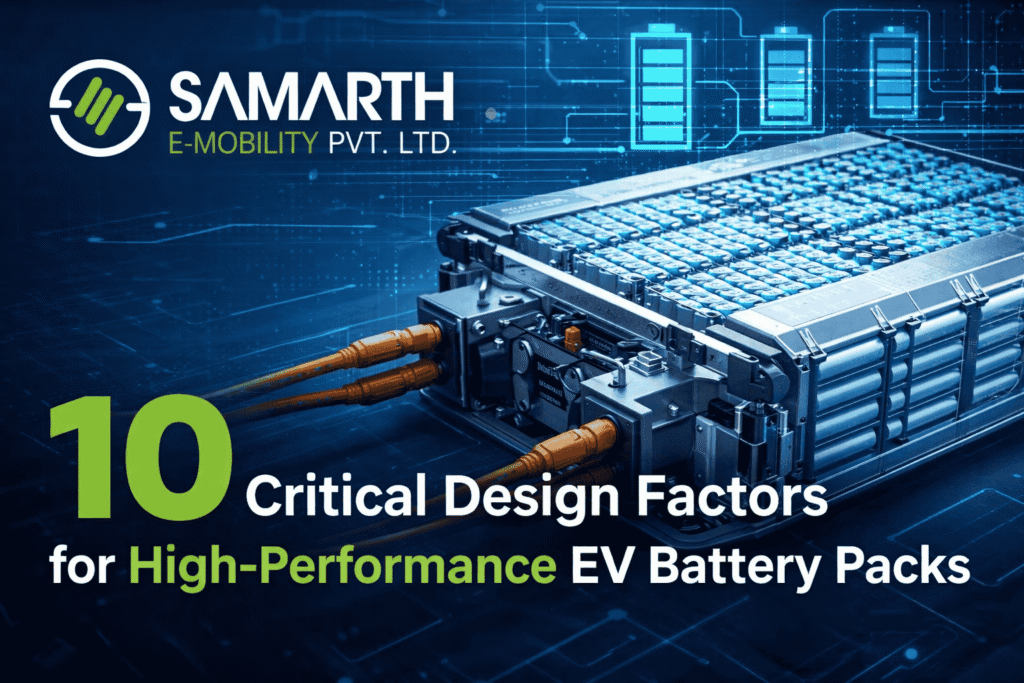

Designing an EV battery pack is far more complex than simply stacking cells together. Each design decision—from thermal pathways to electrical routing—directly impacts safety, performance, efficiency, lifecycle cost, and manufacturability. Poor choices compound over thousands of cycles, turning a promising pack into a warranty nightmare. With over 51,382 km of real-world riding, 1,564 battery life cycles tested, and a high-energy 72 V, 5 kWh NMC pack platform already validated, Samarth E-Mobility engineers these decisions from day one with field data in mind. This guide covers the 10 most critical factors every EV battery engineer must master to build packs that deliver consistent performance and reliability in real-world conditions.
1. Thermal Management: The Make-or-Break Foundation
Thermal management isn’t optional—it’s the single most important pack design decision. Cells generate heat during charge/discharge, and poor dissipation accelerates degradation, reduces safety margins, and limits power delivery. Samarth E-Mobility’s packs are tested from -25°C to 57°C operating conditions, ensuring thermal strategies work from winter cold starts to peak Indian summers.
Key considerations:
- Heat generation mapping: High-power cells in the pack’s centre need more cooling than edge cells
- Thermal gradients: Limit cell-to-cell temperature differences to <3°C during operation
- Phase change materials (PCM) or active cooling for high-performance packs
- Hotspot prediction through CFD simulation before prototyping
Pro tip: Design for worst-case ambient + worst-case duty cycle, not lab conditions. Indian summer + stop-go traffic = your real design constraint.
2. Potting & Thermal Relief: Stress Management at Scale
Potting compounds and thermal relief features manage mechanical stress from thermal expansion, vibration, and crash scenarios while maintaining heat transfer paths.
Critical decisions:
- Thermal conductivity vs. mechanical compliance: Higher conductivity potting improves cooling, difficult to manage mechanical challenges.
- Selective potting: Only pot high-stress areas; leave cooling paths unblocked
- Coefficient of thermal expansion (CTE) matching between cells, potting, and housing
- Vibration isolation without compromising electrical integrity
Reality check: 70% of field failures trace back to mechanical stress cracking connections or delaminating potting from cells.
3. Cell Cycle Life: Design for 3000+ Cycles Minimum
Cell cycle life determines total vehicle economics. A pack that loses 20% capacity after 1000 cycles kills resale value and fleet ROI.
Selection criteria:
- Cycle life @ 80% capacity retention under real duty cycles (not lab C/3)
- High-rate capability without accelerated degradation
- Validated field data from similar applications, not just manufacturer datasheets
Engineer’s rule: If cycle life claims sound too good to be true, they are. Demand third-party validation.
4. Cell Balancing: Active vs. Passive Showdown
Imbalanced cells = pack capacity. Even 10mV differences compound over cycles, forcing premature cutoff.
Passive balancing:
- Pros: Simple, cheap, low instantaneous power dissipation
- Cons: Slow (hours), generates heat, can’t recover deep imbalances
Active balancing:
- Pros: Fast (minutes), recovers imbalances, extends pack life
- Cons: Complex, expensive, adds failure points
Compactness and cost play a major role in the choice of balancing architecture for BMS for a battery pack. Engineering teams at Samarth E-Mobility weigh these trade-offs carefully for each platform segment.
5. Balanced Electrical Architecture: Parallel vs. Series
Electrical architecture determines current paths, fault tolerance, and degradation behaviour.
Key design rules:
- Current density limits: <2 A/mm² in busbars, <5 A/mm² in cell tabs
- Parallel strings: Balance capacity and degradation rates across strings
- Fuse protection: Fast-acting fuses sized for max current + 25% margin
- Redundancy: Dual current paths prevent single-point failures
Common mistake: Undersized busbars that become thermal bottlenecks under high C-rate discharge.
6. Internal Resistance (IR): The Silent Performance Killer
High IR = voltage sag = reduced power and range. IR also increases heat generation (P = I²R).
Target specs:
- DCIR @ 1C: <20 mΩ (packs)
- DCIR @ 2C: <30 mΩ (high-performance pack)
- ACIR @ 1kHz: <10 mΩ (controller matching)
IR matching rules:
- Cell-to-cell variation <1%
- String-to-string variation <2%
- Fresh vs. aged cell matching during pack assembly
7. Cell Capacity: More Isn’t Always Better
Higher capacity sounds great until weight, volume, and degradation reality hits.
Optimization framework:
- Target range → Required kWh → Usable energy density → Cell selection
- Cycle life priority → Conservative C-rate → Lower capacity per cell
- Power priority → High-rate chemistry → Moderate capacity
The 18650 vs. 46800 dilemma: The 46800 cell has a larger cylindrical surface area, which allows a higher heat transfer rate and better thermal management, and its internal resistance is very low compared to 18650 & 21700.
8. Operating Voltage: Balancing Efficiency and Safety
Pack voltage determines motor/controller efficiency but also insulation, creepage, and safety requirements.
Design sweet spot:
- 48-72V: Two-wheeler sweet spot (safety + efficiency
- 96-144V: Performance motorcycles (controller optimized)
- High-voltage (>200V): Future automotive crossover platforms
Critical: Match pack voltage precisely to controller DC bus capability. By maximizing effective utilized DC bus voltage leads to less loss (higher efficiency). This voltage–architecture co-optimization is a core principle inside Samarth E-Mobility’s powertrain engineering.
9. Cell Positioning & Orientation: Thermal + Mechanical Optimization
Cell arrangement affects everything from cooling efficiency to crash safety.
Optimal strategies:
- Prismatic: Vertical orientation maximizes convection
- Cylindrical: Hexagonal packing + air gaps for cooling
- Staggered rows: Improves airflow, reduces thermal gradients
- Edge cooling priority: Hottest cells get best cooling paths
Crash consideration: Orient cells to minimize puncture risk and maximize structural integrity.
10. Electrical Connections & Interconnections: The Reliability Weak Point
70% of battery field failures trace to connection issues. Welding quality determines pack lifespan.
Wire Welding:
- Pros: Flexible, vibration-resistant, Fuse at individual cell
- Cons: High resistance, parallel path disconnection while overcurrent
- Use case: high precision packs & Double/triple wire bonding to mitigate resistance impact
Spot Welding:
- Industry standard for cylindrical cells
- Requires 100% pull-test validation
- Nickel strip thickness = 0.15-0.2mm typical
Laser Welding:
- Pros: Lowest resistance, highest strength
- Cons: High CAPEX, requires precision fixturing
- Best for: Busbar-to-terminal, high-current paths
Quality gates:
- 100% weld inspection (ultrasonic or X-ray for critical welds)
- Pull strength >15N per weld
- Resistance measurement per connection (<0.5 mΩ target)
Manufacturing Reality Check: Design Must Scale
Every design decision must pass three filters:
- Thermal validation: CFD + thermal chambers simulating worst-case duty cycles
- Mechanical testing: 10g RMS vibration, drop tests, crash simulation
- Manufacturing tolerance stack-up: Can production hit your specs at scale?
The OEM trap: Designing for lab perfection but not field reality. Packs must survive potholes, dust, rain, and inconsistent charging for 3+ years. This is why Samarth E-Mobility’s validation plans are built around Indian duty cycles and environmental stress, not idealized test benches.
The Systems Engineering Perspective
Battery pack design success comes from treating the pack as a complete electromechanical-thermal system, not a collection of cells + BMS. Each decision ripples through:
- Poor thermal → Accelerated aging → Capacity fade
- High IR → Voltage sag & Thermal → Range anxiety
- Weak connections → Field failures → Warranty costs
- Imbalanced cells → Premature pack end-of-life
The winning formula: High-precision engineering + manufacturing discipline + field validation data. Packs that survive 3 years with 85% capacity retention and zero safety incidents win the market—and this systems-first philosophy is exactly how Samarth E-Mobility approaches next-generation EV battery pack design.

Driving into the Future
Insights, Innovations, and Ideas Driving the Future of Electric Mobility
