How Climate and Driving Habits Affect EV Battery Life (Especially in India)
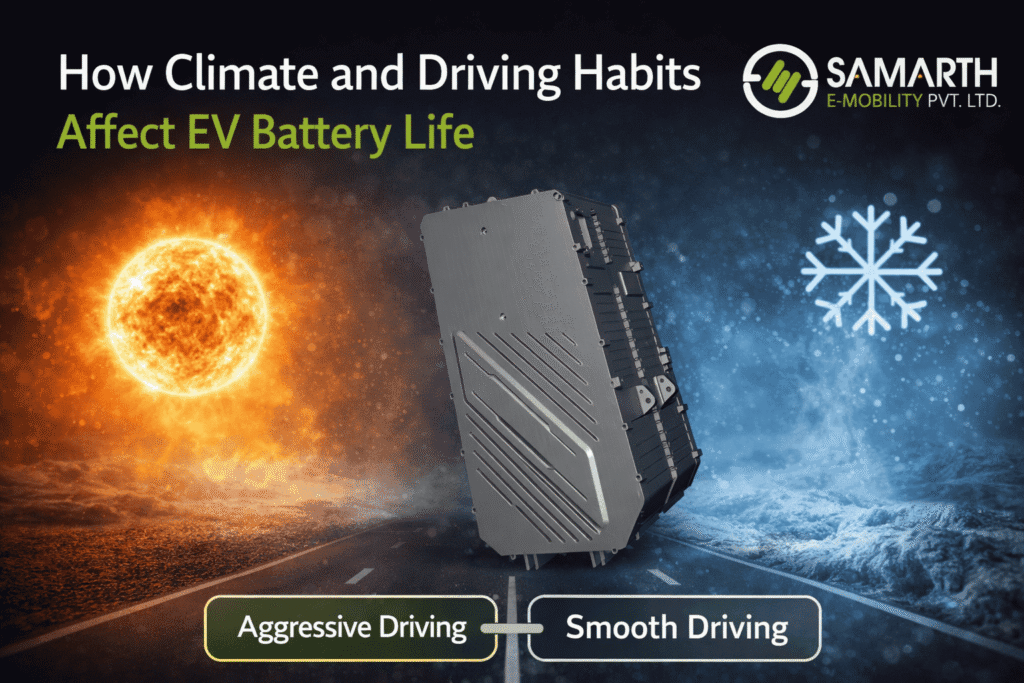

Electric vehicles are simpler than petrol machines in many ways—but their batteries are surprisingly sensitive to the world around them. Two riders with the same EV can see very different battery ageing, purely because of where they live and how they ride. Climate and driving habits are the hidden levers that quietly decide how long an EV battery will deliver strong range and performance. Understanding these factors is the first step to protecting both your battery and your long-term running costs.
How temperature affects EV batteries
Lithium-ion cells work best in a moderate temperature band, typically around 20–35°C. Outside this window, things start to change quickly.
High heat (common in Indian summers)
- Speeds up chemical reactions inside the cell.
- Accelerates growth of the SEI (solid electrolyte interphase), permanently reducing capacity.
- Makes high-current fast charging and aggressive riding more damaging.
Low temperatures
- Reduce available power and range temporarily.
- Increase internal resistance, causing more voltage sag.
- Can lead to lithium plating if you charge too hard when cells are very cold.
In hot regions and crowded cities, batteries spend a lot of time at elevated temperatures—during parking, charging, and riding. Over years, this is one of the biggest contributors to capacity loss.
Samarth E-Mobility designs its 72 V, 5 kWh battery systems and AI-enabled BMS around this reality, validating performance from roughly -25°C to 57°C and tuning protection and control specifically for harsh Indian thermal conditions.
Parking and storage: the silent climate factor
Many owners think about battery stress only while riding or charging, but parking habits matter just as much.
- Parking for hours in direct sun (especially at high SOC) raises pack temperature even when the vehicle is off.
- Keeping the vehicle at 100% charge for long periods accelerates ageing, particularly in hot climates.
- Long-term storage at very low SOC can also be harmful if cells drift too low over time.
Better practices include:
- Parking in shade or covered areas whenever possible.
- Avoiding leaving the battery at 100% for days—charge closer to full just before you actually need the range.
- For long storage, keeping the battery in a mid-SOC window (around 40–60%) rather than full or near empty.
How driving style affects battery life
Driving (or riding) habits control how hard the battery is pushed in day-to-day use. High stress doesn’t always show up immediately, but it adds up over hundreds of cycles.
Key behaviour patterns:
Aggressive acceleration and high speeds
- High C-rate discharge heats the cells and increases mechanical and chemical stress.
- Frequent full-throttle launches and sustained top-speed runs shorten long-term life compared to smoother, moderate acceleration.
Stop-go traffic with hard braking and sudden bursts
- Repeated peaks of current cause mini thermal cycles within the pack.
- If the BMS and cooling are not tuned well, hotspots can form and age certain cells faster.
Riding heavily loaded or on steep gradients
- Increases average current draw, especially at low speeds where cooling may be less effective.
- If done frequently in high ambient temperatures, it can noticeably accelerate degradation.
None of this means you must ride like a robot—but being aware that “how hard you ask the battery to work” directly influences its lifespan helps you choose when to push and when to ease off.
The impact of fast charging and charging habits
Charging is where climate and behaviour intersect most strongly.
Fast charging in high heat
- One of the most stressful combinations for a battery.
- High current + high temperature + high SOC = faster ageing.
Always charging to 100%
- Convenient, but keeping cells at full charge for long periods—especially in hot weather—accelerates long-term capacity loss.
Frequent shallow top-ups vs. deep cycles
- Moderate, shallow cycles (for example 30–80%) are generally gentler on the battery than constant full cycles from low to 100%.
Smart habits to protect life:
- Use fast charging when you need it, not every single time.
- If your typical daily usage is well below the full range, avoid charging to 100% every day.
- Let the battery cool a bit after a hard ride before plugging into a fast charger if possible.
How intelligent BMS helps in the background
Modern, intelligent Battery Management Systems can compensate for some harsh climate and usage patterns by:
- Limiting charge current when the pack is too hot or too cold.
- Adjusting maximum charge voltage slightly based on temperature.
- Reducing discharge power automatically in extreme conditions to protect cells.
- Actively balancing cells so that weak ones don’t drag the whole pack down.
You may not see these interventions, but they quietly trade a little peak performance in tough moments for a lot more life over the long run. In effect, a good BMS acts as a guardian between real-world abuse and the fragile chemistry inside the cells.
Samarth’s AI-enabled smart BMS, with fast cell balancing, high-accuracy sensing, and real-time edge diagnostics, is specifically designed to read climate and usage patterns and dynamically adjust how the pack is charged and discharged to slow down ageing.
Practical tips for Indian EV owners
Bringing it all together, here are simple, climate- and behaviour-aware habits that meaningfully extend battery life:
- Avoid long parking in direct sun when you can; choose shade or covered areas.
- Don’t leave your EV at 100% charge for days—charge closer to your ride time.
- Use fast charging when needed, but don’t rely on it for every single charge.
- Ease off constant full-throttle riding, especially in peak heat or with heavy loads.
- During winters, expect some temporary range reduction and avoid very hard fast charging on an ice-cold battery.
The bigger picture: why this matters for resale and TCO
Battery health directly influences:
- Your daily usable range.
- How long before you have to think about repair or replacement.
- The resale value of your EV when you upgrade.
Climate and driving habits are the two factors you can’t fully control—but you can manage how your vehicle experiences them. Combined with a well-designed pack and intelligent BMS, sensible habits can easily add years of useful life and preserve more of your battery’s original capacity.
In a country as climatically diverse and usage-intense as India, that difference in battery health is exactly what separates EVs that feel “fresh” even after years from those that users abandon early.

Driving into the Future
Insights, Innovations, and Ideas Driving the Future of Electric Mobility