Breaking the Engineering Triangle: How Samarth E Mobility Delivers 53.31 Nm Torque and 93% Efficiency Without a Weight Penalty

Electric vehicle motors have traditionally been constrained by what many engineers call the “Engineering Triangle”: if you want more torque, you either push more current through the motor or make the motor bigger and heavier. Both approaches come with penalties—higher copper losses and heat on one side, added mass and duller dynamics on the other. Samarth E Mobility set out to escape this trap and developed a traction motor that delivers 53.31 Nm of torque and 93% efficiency without adding weight or resorting to brute-force current. This blog explains the engineering thinking behind that outcome and why it matters for the next generation of EV platforms.
The Engineering Triangle Problem
In classical traction motor design, torque, current, and size are tightly coupled. For a given electromagnetic topology, higher torque usually means either raising phase current or increasing motor volume with more copper and iron. Higher current drives copper losses proportional to I2R, creating thermal stress and lowering efficiency, while a physically larger motor adds mass, cost, and compromises packaging. In two-wheeler platforms, these trade-offs are especially painful because extra weight harms agility and range, and high current density demands bulkier cooling hardware and conservative duty cycles.
Instead of asking “How do we push more current safely?”, Samarth’s engineering team asked a different question: “How do we achieve the required torque with less current and no weight penalty?” The answer is a system-level solution that treats the battery, inverter, and motor as a single optimization problem rather than three isolated components.
High Voltage Architecture: Torque Without Current Penalty
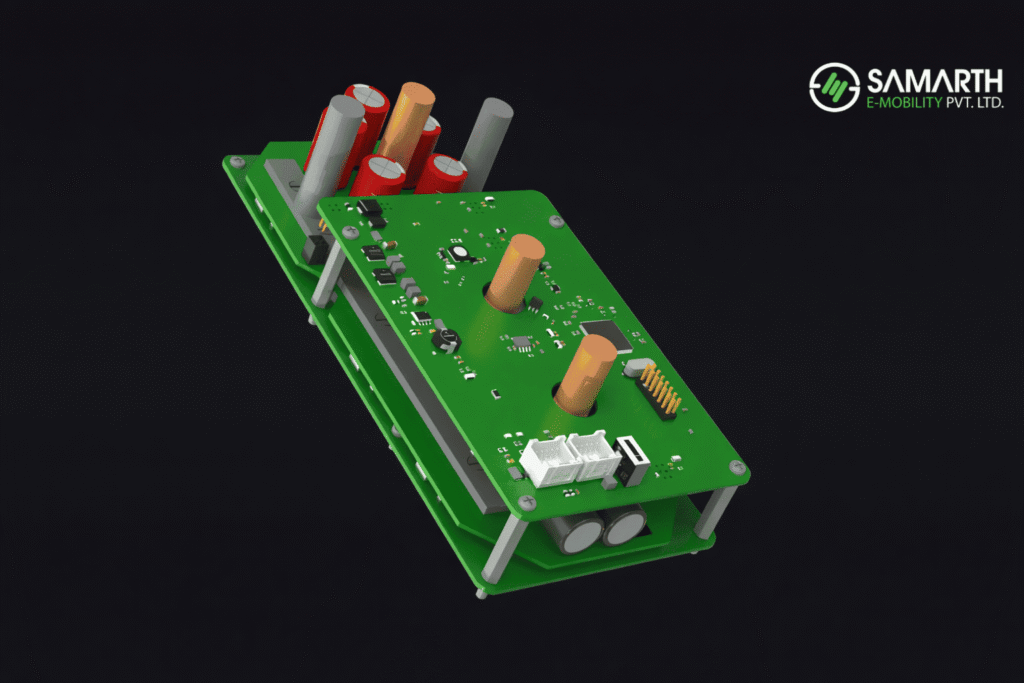
The core lever is a high-voltage system architecture, with the entire chain—from battery pack to inverter to motor—optimized for elevated DC bus voltage. For a given mechanical power, increasing voltage allows a proportional reduction in current, and because copper losses scale with the square of current, even moderate current reduction yields a large drop in I2R losses.
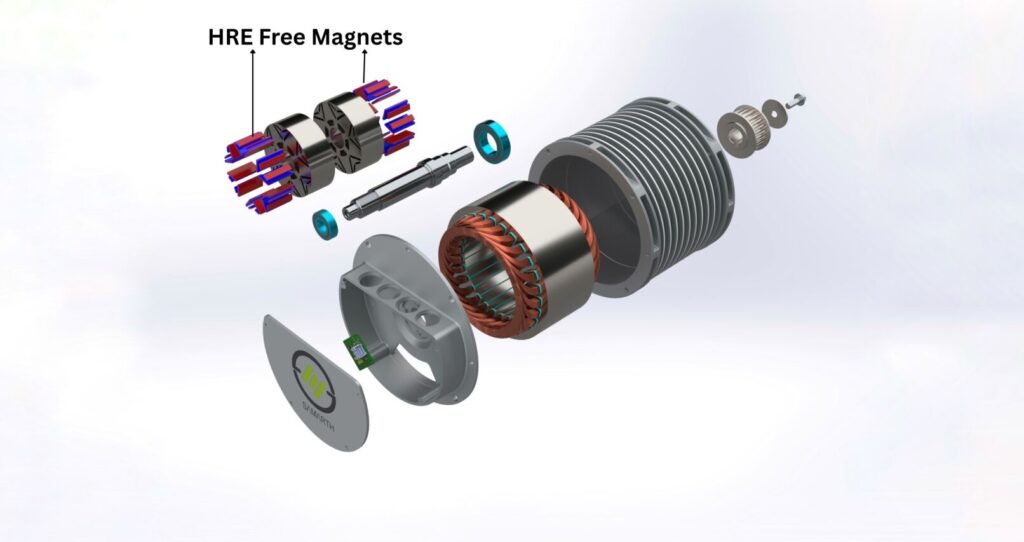
In Samarth’s architecture, voltage is increased within safe insulation, creepage, and clearance limits for a two-wheeler platform, while the inverter uses devices and switching strategies tuned for high voltage and lower current. The motor winding scheme, magnet selection, slot/pole combination, back-EMF profile, and FOC control strategy are co-optimized around this higher-voltage domain so that torque targets are met at reduced phase current without increasing outer diameter or stack length.
Tight System Integration: Motor as Powertrain, Not Part
Most EV designs treat the motor, controller, and battery as separate subsystems with loosely related constraints. Samarth’s approach is to treat them as one integrated powertrain, aligning mechanical and electrical design decisions with vehicle-level performance targets.
This tight integration includes matching the motor’s torque–speed envelope to the vehicle’s performance curve and gear ratio, co-designing inverter current limits, switching strategy, and thermal paths around the motor’s allowable temperature rise, and selecting cell chemistry and pack configuration for the required voltage and current capability instead of sizing the pack in isolation. System-level simulations across standard and aggressive drive cycles help flatten efficiency holes, ensure that typical cruising points lie inside the high-efficiency band, and avoid oversizing the motor or battery “just in case,” which is a common cause of weight creep.
The Numbers That Matter
1. 53.31 Nm Torque – ICE-Like Roll-On
A peak torque of 53.31 Nm at the motor shaft, when paired with an appropriate reduction ratio, translates into wheel torque comparable to mid-capacity ICE motorcycles in real-world roll-on acceleration. Riders experience strong off-the-line performance and confident overtakes with the instant, linear response characteristic of electric motors. Achieving this torque level without pushing current margins to the limit is what makes the high-voltage, low-current architecture sustainable in daily use.
2. Halved I2R Losses – Low Current Density Design
By operating at higher voltage and optimizing turns per phase, current density in the copper conductors is significantly reduced. Since copper losses scale with I2R, halving current can theoretically reduce these losses to roughly one quarter, subject to modest changes in resistance from winding design constraints. The result is lower steady-state winding temperatures for the same load, more thermal headroom for transient peaks such as hard launches or steep gradients, and reduced thermal stress on insulation—contributing to long-term reliability.
3. 93% Efficiency – Real-World Range Multiplier
A motor efficiency around 93% in the key operating region directly impacts vehicle range and usable energy per charge. While pack capacity in kWh dominates specification sheets, system efficiency determines how many of those watt-hours turn into kilometres. At this efficiency level, combined with an optimized inverter and drivetrain, the same range can be achieved with a smaller pack, or more range can be delivered from the same pack—enabling use cases such as intercity riding or heavier payloads without oversizing the battery.
4. Smaller Battery, Stronger Unit Economics
Improved powertrain efficiency reduces the energy required to complete a given test cycle, which allows a smaller-capacity battery to meet the same certified and real-world range targets. Fewer cells lower the Bill of Materials, simplify pack packaging, and reduce vehicle mass, which in turn improves acceleration, braking, and handling. This is where engineering rigor converts directly into better margins and more competitive pricing in a price-sensitive EV market.
Why “No Weight Penalty” Changes Ride Dynamics
On a two-wheeler, every extra kilogram alters dynamics and rider confidence. Mass located high in the frame or far from the center of gravity degrades turn-in, mid-corner stability, and perceived agility, while oversize motors and packs often force heavier frames, stiffer suspension, and stronger brakes—all adding more weight. By delivering required torque and range without scaling up motor or pack mass, Samarth preserves the agile, “light on its feet” character essential for urban and peri-urban riding.
Keeping the motor compact and the pack right-sized also helps control unsprung mass where hub or near-axle mounting is used and enables more natural vehicle ergonomics and packaging. The result is performance without penalty—not just in terms of acceleration figures but in how predictably and intuitively the vehicle behaves for real riders.
2025 Market Reality: Efficiency as a Baseline
The EV two-wheeler market in 2025 is moving from experimentation to consolidation, with buyers increasingly unwilling to trade off performance, range, and value. Platforms that rely on oversizing motors and batteries to mask inefficiencies will struggle against rising material costs, heavier vehicles that require more robust chassis components, and lower real-world range per kWh that undermines fleet and retail economics.
The likely winners will be OEMs that deliver ICE-like performance metrics alongside high efficiency, smaller packs, and competitive BOM structures. Samarth E Mobility’s 53.31 Nm, 93% efficient, no-weight-penalty motor architecture is a concrete expression of that philosophy: not a rejection of motor physics, but a reframing of the design problem at system level using high voltage architecture and tight integration to escape the traditional Engineering Triangle.

Driving into the Future
Insights, Innovations, and Ideas Driving the Future of Electric Mobility